There is a particular moment, just after the train rounds the last bend from Truro and the masts of Falmouth come into view, when the whole story of this town suddenly makes sense. The water is impossibly wide, the hillsides tumble down to a forest of yacht rigs and working boats, and somewhere behind the slate roofs you can almost catch the scent of fish smoke, sea salt and frying butter. Falmouth was built by the sea, and for the sea, and four centuries of merchants, smugglers, packet captains, oyster dredgers and innkeepers have left their fingerprints on every quay. To eat and drink in Falmouth today is to taste a place that has been thinking about food, ships and the wider world for a very long time.
The Harbour That Made A Town
Begin with the geography, because everything else flows from it. The estuary of the River Fal, locally known as the Carrick Roads, is a drowned valley carved out at the end of the last ice age. It reaches depths of up to 34 metres and is generally cited as the third deepest natural harbour in the world, behind Sydney and the Port of Mahon, and the deepest in Western Europe. Large vessels can lie at anchor a stone’s throw from the quay, sheltered from Atlantic storms by the curve of the Roseland Peninsula. Mariners have long called Falmouth the “first and last port” for ships crossing the western approaches, and that simple fact has shaped everything from the menu of the Chain Locker to the existence of the town itself.
In the early sixteenth century there was no Falmouth to speak of. The medieval market town of Penryn, just inland, had held the trade since the thirteenth century. Where Falmouth now stands there were only a few cottages at “Smithick, alias Pennycomequick”, the latter an Anglicisation of the Cornish Pen-y-cwm-cuic, meaning “head of the creek”. Brooding above this hamlet stood Arwenack, the seat of the Killigrew family, who had inherited the estate by marriage in the fourteenth century when Simon Killigrew wed Jane Arwenack.
Henry VIII transformed the headland. Between 1539 and 1545, fearing a Catholic alliance of France, Spain and the Holy Roman Empire after his break with Rome, he built two artillery forts to guard the Carrick Roads as part of his nationwide Device programme. Pendennis Castle, with its squat circular Tudor keep, rose on the western promontory; St Mawes Castle, its more decorated sibling, faced it across the water. John Killigrew was appointed Pendennis’s first captain, and for the next century the family combined royal service with a side line in piracy and the receiving of stolen goods. Lady Mary Killigrew was actually convicted of piracy in the 1580s, having sent her servants to raid a Spanish ship sheltering in the Roads, and was reprieved from the gallows only by Queen Elizabeth I.
Charles II, A Royal Charter, And A Town Is Born
The Killigrews dreamed bigger than smuggling. Sir Walter Raleigh, visiting Arwenack in 1598 while inspecting Pendennis’s defences, reportedly told Sir John Killigrew that the sheltered creek below his house was perfect for a port. Building began in earnest around 1613, though Penryn, Truro and Helston, sensing a rival, fought the venture bitterly in the courts.
Then came the Civil War, and Pendennis Castle took its place in legend. The garrison declared for King Charles I, and after the Royalist collapse in the West Country, the fortress endured a five-month siege from March to 17 August 1646, the last Royalist stronghold on the English mainland to surrender. Around a thousand men, women and children inside the walls held out until starvation forced their hand. Queen Henrietta Maria and the future Charles II had earlier sheltered at Pendennis before escaping to France, and the family of Sir John Arundell, who commanded the siege, became Cornish heroes.
When Charles II was restored to the throne in 1660, he did not forget his loyal Cornish subjects. On 5 October 1661, Sir Peter Killigrew received a Royal Charter incorporating the town. The document, displayed by the National Maritime Museum Cornwall during its Falmouth 350 exhibition in 2011 to 2012, describes Sir Peter as “our beloved and faithful subject” and grants the charter “in consideration of the good, faithful, and acceptable services, by him the said Peter as well to Us, as to our most dear Father, the Lord Charles, late king of England (of glorious memory).” A separate clause sweeps away the old name altogether: “that Village from henceforth shall not be called, named, or known by the name of the Village of Smythwicke, but in all times hereafter shall be called, named, or known by the name of our Town of Falmouth.” Susan E. Gay’s seminal study Old Falmouth, published in 1903, remains the standard account of the period; the borough records themselves are preserved at Kresen Kernow, formerly the Cornwall Record Office.
The price of incorporation was a church. Sir Peter laid the foundations of King Charles the Martyr on 29 August 1662; the building was consecrated on 22 August 1665 by Dr Seth Ward, Bishop of Exeter, and it remains the parish church to this day, dedicated to the executed king and bankrolled in part by Charles II and the Duke of York. With the customs house transferred from Penryn and a brand new High Street, Market Street and Church Street laid out across roughly 31 acres of land, Falmouth was at last open for business.
Packet Ships And A Place On The Map Of The World
The making of Falmouth as a place of global consequence came in 1689, when the General Post Office chose the harbour as the base for its overseas mail service. The Falmouth Packet Service ran from 1689 until the final packet, the Seagull, returned from Rio de Janeiro in May 1851. For more than 160 years, small fast-sailing brigs of around ten guns, privately owned but operated under Post Office contract, sailed from Falmouth to Corunna and Lisbon, then to the West Indies (from 1702 under Edmund Dummer’s pioneering monthly service), New York, Halifax, Buenos Aires, Gibraltar, Malta, and from the 1830s onward to Egypt and India.
Falmouth’s position made it perfect for the work. As the most westerly deep-water port, it offered the shortest sea passage to the Atlantic without the dangerous slog up and down the Channel under the guns of French privateers. The packet captains became wealthy and famous. Many settled in the village of Flushing, across the water, where Samuel Trefusis had built warehouses and water tanks for the trade after marrying into the family of the Postmaster General. News of Nelson’s victory and death at Trafalgar reached Falmouth aboard HM Schooner Pickle on 4 November 1805; her commander, Lieutenant John Richards Lapenotière, then covered the 271 miles to the Admiralty in London in 37 hours by post-chaise, changing horses 21 times, a feat now commemorated by The Trafalgar Way. Lord Byron sailed for Lisbon on His Majesty’s Packet Princess Elizabeth in 1809, and immortalised the cramped, sea-sick passage in a comic poem to his friend the Reverend Hodgson. The packets carried bullion, diplomatic dispatches and ordinary letters, fought off French warships when they had to, and were captured with appalling regularity. In 1810 the crews mutinied over the loss of their private trading rights, the service was briefly punished by relocation to Plymouth, and only a fierce lobbying campaign brought it back to Falmouth in February 1811.
The arrival of steam ended the romance. From the 1820s the wind-powered packets were progressively replaced; from 1840 mail was redirected to Liverpool, and by 1851 the station closed.
Oysters, Pilchards And A Working Harbour
While the packet captains made fortunes in bullion, ordinary Falmouth lived by the fish. Pilchards, those small oily silver herring relatives now rebranded as Cornish sardines, were the foundation of the rural Cornish economy from the Tudor period onwards. Between 1747 and 1756, according to The Maritime History of Cornwall (University of Exeter Press), the annual average export of pilchards from Cornwall was 29,795 hogsheads, much of it shipped through Falmouth and on to Catholic Italy and Spain via the great Cornish merchant houses of Fox of Falmouth and Bolitho of Penzance. The first canned pilchards left Mevagissey in 1874 under G. C. Fox of Falmouth’s “Cornish Sardine Co.” label, and the trade continued in some form until the 1960s.
The oyster fishery is older still, and unique. The native flat oyster, Ostrea edulis, has been gathered from the beds of the Truro and Fal rivers since Roman times. In 1602 the antiquarian Richard Carew described local fishermen using “a thick strong net fastened to three spills of iron, and drawn to the boat’s stern”. When disease, pollution and overfishing pushed the beds to near-collapse in the 1860s, Truro Corporation passed a remarkable piece of conservation legislation: byelaws in 1876 prohibiting the use of mechanical power, requiring oysters to be dredged only under sail or oar, with hand-hauled dredges. That order survives in modified form today as the Fal Fishery Regulatory Order, most recently updated in 2016 and amended in 2025. The result is the last commercial sailing oyster fleet in Europe, a fleet of 28-foot gaff-rigged Falmouth Working Boats drifting downwind across the beds between 1 October and 31 March each year. The Fal Oyster has held EU Protected Designation of Origin status since 13 November 2013, and in the 2023 to 2024 season around 31 tonnes of natives were landed.
Smuggling, of course, ran in parallel with both trades. In Chapter 8 of The Maritime History of Cornwall, “Corruption and Inefficiency in the Cornish Customs Service in the Later Seventeenth Century”, the historian W. B. Stephens documents that “the customs duties at Falmouth and Penryn ‘had been almost totally Run’ because of ‘the great Corruption of the officers.’” The wooded creeks of the Helford River had such a reputation that locals nicknamed it “Stealford”. The notorious Carter brothers of Prussia Cove unloaded brandy at Helford village itself in the 1780s, and in one celebrated 1785 episode a gang of forty men broke into the Queen’s warehouse at Helford to liberate 130 barrels of seized French brandy, leaving three behind in mocking sympathy for the revenue men. The Killigrews themselves were rumoured to have made part of their fortune from receiving stolen goods, and in 1763 three East Indiamen anchored in Falmouth Bay reportedly held an open bazaar from their decks for a fortnight, selling £20,000 worth of silk, china and tea free of duty.
A Town Of Pubs And Inns
This is the world that built Falmouth’s pub culture, and most of the great ones are still pouring pints today. The Seven Stars on The Moor was granted its licence in 1660, a year before the Royal Charter; the same family has run it for seven generations since 1853, and it is on CAMRA’s National Inventory of Historic Pub Interiors. Walk in and you will still find the white marble counter where Hugh Dunstan Richards opened his oyster bar in the nineteenth century, shucking Fal natives for sailors who had just stepped ashore.
The Chain Locker, on Custom House Quay, traces its earliest fabric to the late seventeenth century. It opened as the Maritime Hotel in the 1660s and became a gathering place for coal labourers, lifeboat crews and salvage tug masters; recent restoration uncovered an original earth-and-hair plaster wall and a hidden bread oven. Just along the harbour, The Working Boat sits below the Greenbank Hotel, established in 1876 and rebuilt in 2015. Oystermen have refreshed themselves here for around 150 years, and members of the Falmouth Working Boat Association still gather to sing shanties after racing.
Up Restronguet Creek, the thatched Pandora Inn occupies a building whose origins reach back to the thirteenth century. It was renamed in the 1790s after HMS Pandora, the Royal Navy frigate sent to recapture the Bounty mutineers, which struck the Great Barrier Reef in 1791; her court-martialled captain, Edward Edwards, is said to have bought the inn on his return. Carefully rebuilt after a devastating fire in 2011, it remains one of Cornwall’s most romantic places to eat fresh seafood with your feet practically in the water.
The Quayside Inn on Arwenack Street, a Grade II listed mid-nineteenth century building formerly known as the Globe Hotel (Historic England List Entry 1270124), is woven into the same waterfront tradition, traditionally said to have served sailors and the final years of the Packet trade.
The Railway, The Docks And The Victorian Reinvention
Two events in the 1850s and 1860s pulled Falmouth out of the slump that followed the loss of the Packet Service. The Falmouth Docks Company was formed at a public meeting in the Town Hall on 31 May 1858, and the foundation stone was laid by Viscount Falmouth on 28 February 1860. The first ship to use the new docks was the Danish vessel Frederick VII in 1861, the No. 1 graving dock and grain store followed in 1862, and from 1878 shipbuilding flourished. The Queen Elizabeth Dry Dock, opened by Prince Philip in 1958, was 850 feet long and capable of taking ships of up to 85,000 tons. The Pendennis Shipyard, builders of luxury yachts, relocated here in 1988, and the docks remain Cornwall’s largest port.
The Cornwall Railway reached Falmouth on 24 August 1863. Within two years the foundation stone of The Falmouth Hotel had been laid (1863) and the hotel opened for business on 9 May 1865, the town’s first purpose-built tourist hotel, complete with its own private beach. Tourism flooded in. Family bathing facilities were developed at Gyllyngvase, Swanpool and Maenporth, and the seaside town as we now know it took shape.
Wars And Modern Memory
Twentieth century Falmouth wore two world wars hard. In the First, the Admiralty took over the docks and built the larger No. 3 Dock to cope with U-boat damage. In the Second, an anti-submarine net was strung from Pendennis to St Mawes, the town suffered 12 German bombing raids killing 31 people, and Falmouth became one of the country’s most important embarkation points. On 26 March 1942, the destroyer HMS Campbeltown and 16 small craft slipped out of Falmouth Harbour for Operation Chariot, the raid on the Normandie Dock at St Nazaire on 28 March 1942. Of 622 men who set sail, 168 were killed; five Victoria Crosses were won, including by Able Seaman Bill Savage, who lies in Falmouth Cemetery. The memorial on Prince of Wales Pier was unveiled by the Duke and Duchess of Cornwall on 11 July 2008. The following spring, in May 1943, around 27,000 American troops of the 29th Infantry Division began arriving in the Fal Estuary in preparation for D-Day, with General Eisenhower reportedly staying at Tolverne Cottage and slipways built at Grove Place, Tolverne, Turnaware Bar and on the beach at Trebah Garden.
Today’s Taste Of A Long History
Walk Falmouth today and the layers all show. The Killigrew Monument, the unmarked granite pyramid erected on the orders of Martin Lister Killigrew around 1737, still stands beside Arwenack House. The National Maritime Museum Cornwall, designed by M. J. Long and opened in February 2003, anchors the redeveloped Discovery Quay. The Falmouth Oyster Festival each October celebrates the opening of the dredging season; the Falmouth International Sea Shanty Festival, founded in 2003, has grown to become, according to the National Maritime Museum Cornwall, “the largest free nautical music and song festival in Europe with over 65,000 visitors”; and the high street, named Great British High Street “Coastal Community” winner in 2016, hums with independent restaurants. Among them is Culture, on Custom House Quay, where chef-owner Hylton Espey was awarded Falmouth’s first MICHELIN Green Star in the MICHELIN Guide Great Britain and Ireland 2023.
Cornish food traditions still hold the centre. Pasties remain a staple, born of the tin and copper miners who needed a hand-held lunch. Cream teas, scones layered with jam first and clotted cream second, are taken seriously. Fal oysters, hand-dredged, hand-shucked, are served with little more than lemon and a splash of dry Cornish wine. And in the back bar of the Seven Stars or the Working Boat, with shanties drifting out into the evening, you can still feel the long ghost of the packet captains, the oyster dredgers and the Killigrew pirates moving among the drinkers. Falmouth has been eating, drinking and watching the sea for four hundred years. The view from its quaysides has barely changed, and neither, gloriously, has the appetite.
Category: Falmouth history
-
Falmouth: A Brief History of Cornwall’s Great Harbour Town
-
Falmouth: A Brief History of Cornwall’s Great Harbour Town
There is a particular moment, just after the train rounds the last bend from Truro and the masts of Falmouth come into view, when the whole story of this town suddenly makes sense. The water is impossibly wide, the hillsides tumble down to a forest of yacht rigs and working boats, and somewhere behind the slate roofs you can almost catch the scent of fish smoke, sea salt and frying butter. Falmouth was built by the sea, and for the sea, and four centuries of merchants, smugglers, packet captains, oyster dredgers and innkeepers have left their fingerprints on every quay. To eat and drink in Falmouth today is to taste a place that has been thinking about food, ships and the wider world for a very long time.
The Harbour That Made A Town
Begin with the geography, because everything else flows from it. The estuary of the River Fal, locally known as the Carrick Roads, is a drowned valley carved out at the end of the last ice age. It reaches depths of up to 34 metres and is generally cited as the third deepest natural harbour in the world, behind Sydney and the Port of Mahon, and the deepest in Western Europe. Large vessels can lie at anchor a stone’s throw from the quay, sheltered from Atlantic storms by the curve of the Roseland Peninsula. Mariners have long called Falmouth the “first and last port” for ships crossing the western approaches, and that simple fact has shaped everything from the menu of the Chain Locker to the existence of the town itself.
In the early sixteenth century there was no Falmouth to speak of. The medieval market town of Penryn, just inland, had held the trade since the thirteenth century. Where Falmouth now stands there were only a few cottages at “Smithick, alias Pennycomequick”, the latter an Anglicisation of the Cornish Pen-y-cwm-cuic, meaning “head of the creek”. Brooding above this hamlet stood Arwenack, the seat of the Killigrew family, who had inherited the estate by marriage in the fourteenth century when Simon Killigrew wed Jane Arwenack.
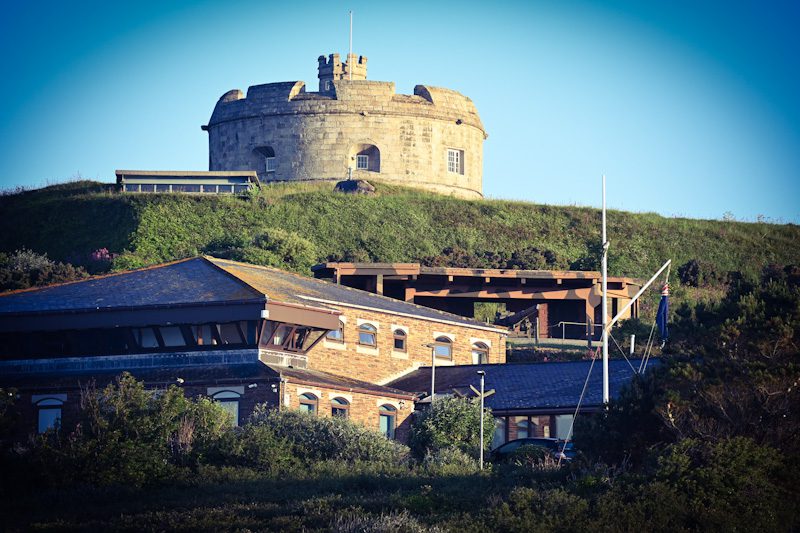
Henry VIII transformed the headland. Between 1539 and 1545, fearing a Catholic alliance of France, Spain and the Holy Roman Empire after his break with Rome, he built two artillery forts to guard the Carrick Roads as part of his nationwide Device programme. Pendennis Castle, with its squat circular Tudor keep, rose on the western promontory; St Mawes Castle, its more decorated sibling, faced it across the water. John Killigrew was appointed Pendennis’s first captain, and for the next century the family combined royal service with a side line in piracy and the receiving of stolen goods. Lady Mary Killigrew was actually convicted of piracy in the 1580s, having sent her servants to raid a Spanish ship sheltering in the Roads, and was reprieved from the gallows only by Queen Elizabeth I.
Charles II, A Royal Charter, And A Town Is Born
The Killigrews dreamed bigger than smuggling. Sir Walter Raleigh, visiting Arwenack in 1598 while inspecting Pendennis’s defences, reportedly told Sir John Killigrew that the sheltered creek below his house was perfect for a port. Building began in earnest around 1613, though Penryn, Truro and Helston, sensing a rival, fought the venture bitterly in the courts.
Then came the Civil War, and Pendennis Castle took its place in legend. The garrison declared for King Charles I, and after the Royalist collapse in the West Country, the fortress endured a five-month siege from March to 17 August 1646, the last Royalist stronghold on the English mainland to surrender. Around a thousand men, women and children inside the walls held out until starvation forced their hand. Queen Henrietta Maria and the future Charles II had earlier sheltered at Pendennis before escaping to France, and the family of Sir John Arundell, who commanded the siege, became Cornish heroes.
When Charles II was restored to the throne in 1660, he did not forget his loyal Cornish subjects. On 5 October 1661, Sir Peter Killigrew received a Royal Charter incorporating the town. The document, displayed by the National Maritime Museum Cornwall during its Falmouth 350 exhibition in 2011 to 2012, describes Sir Peter as “our beloved and faithful subject” and grants the charter “in consideration of the good, faithful, and acceptable services, by him the said Peter as well to Us, as to our most dear Father, the Lord Charles, late king of England (of glorious memory).” A separate clause sweeps away the old name altogether: “that Village from henceforth shall not be called, named, or known by the name of the Village of Smythwicke, but in all times hereafter shall be called, named, or known by the name of our Town of Falmouth.” Susan E. Gay’s seminal study Old Falmouth, published in 1903, remains the standard account of the period; the borough records themselves are preserved at Kresen Kernow, formerly the Cornwall Record Office.
The price of incorporation was a church. Sir Peter laid the foundations of King Charles the Martyr on 29 August 1662; the building was consecrated on 22 August 1665 by Dr Seth Ward, Bishop of Exeter, and it remains the parish church to this day, dedicated to the executed king and bankrolled in part by Charles II and the Duke of York. With the customs house transferred from Penryn and a brand new High Street, Market Street and Church Street laid out across roughly 31 acres of land, Falmouth was at last open for business.
Packet Ships And A Place On The Map Of The World
The making of Falmouth as a place of global consequence came in 1689, when the General Post Office chose the harbour as the base for its overseas mail service. The Falmouth Packet Service ran from 1689 until the final packet, the Seagull, returned from Rio de Janeiro in May 1851. For more than 160 years, small fast-sailing brigs of around ten guns, privately owned but operated under Post Office contract, sailed from Falmouth to Corunna and Lisbon, then to the West Indies (from 1702 under Edmund Dummer’s pioneering monthly service), New York, Halifax, Buenos Aires, Gibraltar, Malta, and from the 1830s onward to Egypt and India.
Falmouth’s position made it perfect for the work. As the most westerly deep-water port, it offered the shortest sea passage to the Atlantic without the dangerous slog up and down the Channel under the guns of French privateers. The packet captains became wealthy and famous. Many settled in the village of Flushing, across the water, where Samuel Trefusis had built warehouses and water tanks for the trade after marrying into the family of the Postmaster General. News of Nelson’s victory and death at Trafalgar reached Falmouth aboard HM Schooner Pickle on 4 November 1805; her commander, Lieutenant John Richards Lapenotière, then covered the 271 miles to the Admiralty in London in 37 hours by post-chaise, changing horses 21 times, a feat now commemorated by The Trafalgar Way. Lord Byron sailed for Lisbon on His Majesty’s Packet Princess Elizabeth in 1809, and immortalised the cramped, sea-sick passage in a comic poem to his friend the Reverend Hodgson. The packets carried bullion, diplomatic dispatches and ordinary letters, fought off French warships when they had to, and were captured with appalling regularity. In 1810 the crews mutinied over the loss of their private trading rights, the service was briefly punished by relocation to Plymouth, and only a fierce lobbying campaign brought it back to Falmouth in February 1811.
The arrival of steam ended the romance. From the 1820s the wind-powered packets were progressively replaced; from 1840 mail was redirected to Liverpool, and by 1851 the station closed.
Oysters, Pilchards And A Working Harbour
While the packet captains made fortunes in bullion, ordinary Falmouth lived by the fish. Pilchards, those small oily silver herring relatives now rebranded as Cornish sardines, were the foundation of the rural Cornish economy from the Tudor period onwards. Between 1747 and 1756, according to The Maritime History of Cornwall (University of Exeter Press), the annual average export of pilchards from Cornwall was 29,795 hogsheads, much of it shipped through Falmouth and on to Catholic Italy and Spain via the great Cornish merchant houses of Fox of Falmouth and Bolitho of Penzance. The first canned pilchards left Mevagissey in 1874 under G. C. Fox of Falmouth’s “Cornish Sardine Co.” label, and the trade continued in some form until the 1960s.
The oyster fishery is older still, and unique. The native flat oyster, Ostrea edulis, has been gathered from the beds of the Truro and Fal rivers since Roman times. In 1602 the antiquarian Richard Carew described local fishermen using “a thick strong net fastened to three spills of iron, and drawn to the boat’s stern”. When disease, pollution and overfishing pushed the beds to near-collapse in the 1860s, Truro Corporation passed a remarkable piece of conservation legislation: byelaws in 1876 prohibiting the use of mechanical power, requiring oysters to be dredged only under sail or oar, with hand-hauled dredges. That order survives in modified form today as the Fal Fishery Regulatory Order, most recently updated in 2016 and amended in 2025. The result is the last commercial sailing oyster fleet in Europe, a fleet of 28-foot gaff-rigged Falmouth Working Boats drifting downwind across the beds between 1 October and 31 March each year. The Fal Oyster has held EU Protected Designation of Origin status since 13 November 2013, and in the 2023 to 2024 season around 31 tonnes of natives were landed.
Smuggling, of course, ran in parallel with both trades. In Chapter 8 of The Maritime History of Cornwall, “Corruption and Inefficiency in the Cornish Customs Service in the Later Seventeenth Century”, the historian W. B. Stephens documents that “the customs duties at Falmouth and Penryn ‘had been almost totally Run’ because of ‘the great Corruption of the officers.’” The wooded creeks of the Helford River had such a reputation that locals nicknamed it “Stealford”. The notorious Carter brothers of Prussia Cove unloaded brandy at Helford village itself in the 1780s, and in one celebrated 1785 episode a gang of forty men broke into the Queen’s warehouse at Helford to liberate 130 barrels of seized French brandy, leaving three behind in mocking sympathy for the revenue men. The Killigrews themselves were rumoured to have made part of their fortune from receiving stolen goods, and in 1763 three East Indiamen anchored in Falmouth Bay reportedly held an open bazaar from their decks for a fortnight, selling £20,000 worth of silk, china and tea free of duty.
A Town Of Pubs And Inns
This is the world that built Falmouth’s pub culture, and most of the great ones are still pouring pints today. The Seven Stars on The Moor was granted its licence in 1660, a year before the Royal Charter; the same family has run it for seven generations since 1853, and it is on CAMRA’s National Inventory of Historic Pub Interiors. Walk in and you will still find the white marble counter where Hugh Dunstan Richards opened his oyster bar in the nineteenth century, shucking Fal natives for sailors who had just stepped ashore.
The Chain Locker, on Custom House Quay, traces its earliest fabric to the late seventeenth century. It opened as the Maritime Hotel in the 1660s and became a gathering place for coal labourers, lifeboat crews and salvage tug masters; recent restoration uncovered an original earth-and-hair plaster wall and a hidden bread oven. Just along the harbour, The Working Boat sits below the Greenbank Hotel, established in 1876 and rebuilt in 2015. Oystermen have refreshed themselves here for around 150 years, and members of the Falmouth Working Boat Association still gather to sing shanties after racing.
Up Restronguet Creek, the thatched Pandora Inn occupies a building whose origins reach back to the thirteenth century. It was renamed in the 1790s after HMS Pandora, the Royal Navy frigate sent to recapture the Bounty mutineers, which struck the Great Barrier Reef in 1791; her court-martialled captain, Edward Edwards, is said to have bought the inn on his return. Carefully rebuilt after a devastating fire in 2011, it remains one of Cornwall’s most romantic places to eat fresh seafood with your feet practically in the water.
The Quayside Inn on Arwenack Street, a Grade II listed mid-nineteenth century building formerly known as the Globe Hotel (Historic England List Entry 1270124), is woven into the same waterfront tradition, traditionally said to have served sailors and the final years of the Packet trade.
The Railway, The Docks And The Victorian Reinvention
Two events in the 1850s and 1860s pulled Falmouth out of the slump that followed the loss of the Packet Service. The Falmouth Docks Company was formed at a public meeting in the Town Hall on 31 May 1858, and the foundation stone was laid by Viscount Falmouth on 28 February 1860. The first ship to use the new docks was the Danish vessel Frederick VII in 1861, the No. 1 graving dock and grain store followed in 1862, and from 1878 shipbuilding flourished. The Queen Elizabeth Dry Dock, opened by Prince Philip in 1958, was 850 feet long and capable of taking ships of up to 85,000 tons. The Pendennis Shipyard, builders of luxury yachts, relocated here in 1988, and the docks remain Cornwall’s largest port.
The Cornwall Railway reached Falmouth on 24 August 1863. Within two years the foundation stone of The Falmouth Hotel had been laid (1863) and the hotel opened for business on 9 May 1865, the town’s first purpose-built tourist hotel, complete with its own private beach. Tourism flooded in. Family bathing facilities were developed at Gyllyngvase, Swanpool and Maenporth, and the seaside town as we now know it took shape.
Wars And Modern Memory
Twentieth century Falmouth wore two world wars hard. In the First, the Admiralty took over the docks and built the larger No. 3 Dock to cope with U-boat damage. In the Second, an anti-submarine net was strung from Pendennis to St Mawes, the town suffered 12 German bombing raids killing 31 people, and Falmouth became one of the country’s most important embarkation points. On 26 March 1942, the destroyer HMS Campbeltown and 16 small craft slipped out of Falmouth Harbour for Operation Chariot, the raid on the Normandie Dock at St Nazaire on 28 March 1942. Of 622 men who set sail, 168 were killed; five Victoria Crosses were won, including by Able Seaman Bill Savage, who lies in Falmouth Cemetery. The memorial on Prince of Wales Pier was unveiled by the Duke and Duchess of Cornwall on 11 July 2008. The following spring, in May 1943, around 27,000 American troops of the 29th Infantry Division began arriving in the Fal Estuary in preparation for D-Day, with General Eisenhower reportedly staying at Tolverne Cottage and slipways built at Grove Place, Tolverne, Turnaware Bar and on the beach at Trebah Garden.
Today’s Taste Of A Long History
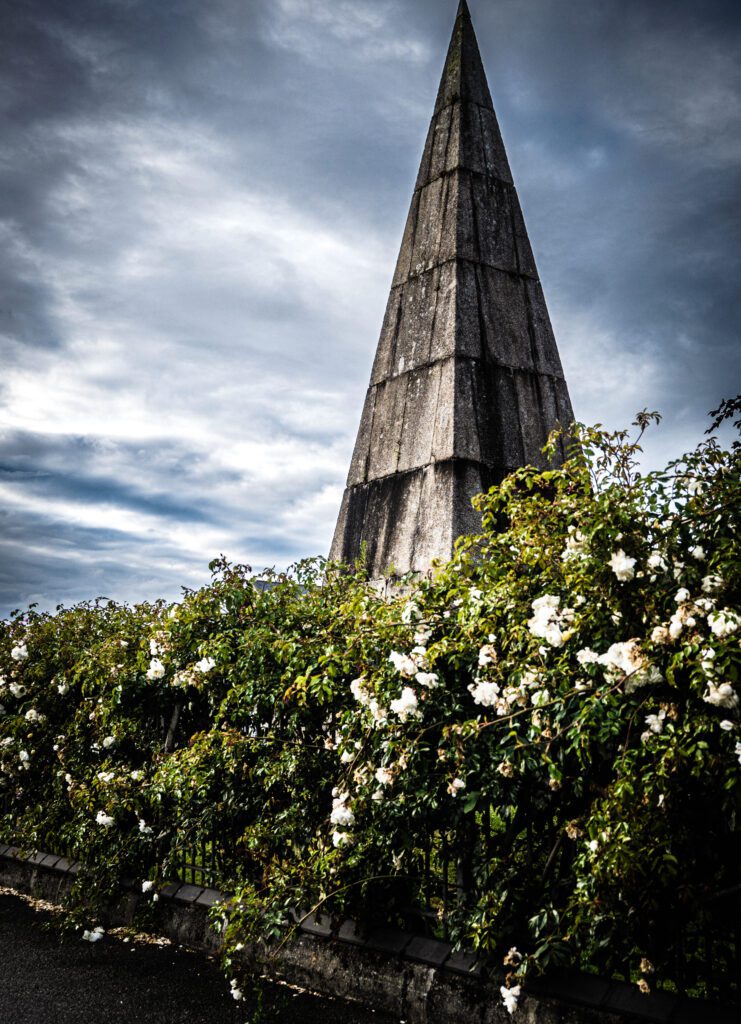
Walk Falmouth today and the layers all show. The Killigrew Monument, the unmarked granite pyramid erected on the orders of Martin Lister Killigrew around 1737, still stands beside Arwenack House. The National Maritime Museum Cornwall, designed by M. J. Long and opened in February 2003, anchors the redeveloped Discovery Quay. The Falmouth Oyster Festival each October celebrates the opening of the dredging season; the Falmouth International Sea Shanty Festival, founded in 2003, has grown to become, according to the National Maritime Museum Cornwall, “the largest free nautical music and song festival in Europe with over 65,000 visitors”; and the high street, named Great British High Street “Coastal Community” winner in 2016, hums with independent restaurants. Among them is Culture, on Custom House Quay, where chef-owner Hylton Espey was awarded Falmouth’s first MICHELIN Green Star in the MICHELIN Guide Great Britain and Ireland 2023.
Cornish food traditions still hold the centre. Pasties remain a staple, born of the tin and copper miners who needed a hand-held lunch. Cream teas, scones layered with jam first and clotted cream second, are taken seriously. Fal oysters, hand-dredged, hand-shucked, are served with little more than lemon and a splash of dry Cornish wine. And in the back bar of the Seven Stars or the Working Boat, with shanties drifting out into the evening, you can still feel the long ghost of the packet captains, the oyster dredgers and the Killigrew pirates moving among the drinkers. Falmouth has been eating, drinking and watching the sea for four hundred years. The view from its quaysides has barely changed, and neither, gloriously, has the appetite. -
Arwenack House: The Lost Manor That Gave Birth to Falmouth
If you stand today on Falmouth’s lively waterfront with coffee in hand, seagulls overhead, and the masts of yachts clinking in the harbou. It’s hard to imagine that this thriving Cornish town began as a single manor house. Yet beneath the bustle lies the story of Arwenack, a once grand estate that helped shape one of Cornwall’s most important coastal towns.
Arwenack is more than just a historical footnote, it is the root from which Falmouth grew, and its story is woven through centuries of ambition, rebellion, piracy, and royal favour.
A Name from the Old Tongue
The name Arwenack itself hints at Cornwall’s deep Celtic past. Derived from the ancient Cornish language, it’s said to mean either “the beloved, still cove” or “upon the marsh.” Both are apt. The land here lies between the gentle inlets of the Fal Estuary, once a quiet, marshy haven that would later become one of the world’s greatest natural harbours, known as the Carrick Roads.
It was this geography that made Arwenack both precious and strategic. The sheltered waters offered safe anchorage to ships and easy access to trade routes, but also made it a tempting prize for those who sought control of Cornwall’s coast.
From the de Arwenacks to the Killigrews
The earliest known lords of the manor were the de Arwenack family, recorded as early as the 13th century. When the last of their line, Jane de Arwenack, married Simon Killigrew around 1377, the manor passed to one of the most colourful families in Cornish history, the notorious Killigrews.
From that point on, Arwenack became their stronghold, and for the next three centuries, the Killigrews would dominate both local and national affairs. They were courtiers, merchants, governors, pirates, and sometimes all four at once.
Simon Killigrew’s descendants expanded the estate and built the first iteration of Arwenack House, a grand residence overlooking the sea. It was a fitting base for a family whose ambitions would soon stretch far beyond Cornwall.
The Killigrews: Fortune and Folly
Few Cornish dynasties embody the contradictions of the age like the Killigrews. They were loyal servants of the Crown, yet often lawless at home. The family produced Members of Parliament, ambassadors, and royal courtiers—but also smugglers, pirates, and scandalous socialites.
John Killigrew (died 1567) became the first Governor of Pendennis Castle, the great fortress built by Henry VIII on Killigrew land to defend England’s western flank. A monumental brass to him still survives in nearby St Budock’s Church, depicting him beside his wife Elizabeth Trewennard. He was praised as a man of status and influence, rebuilding Arwenack House into what contemporary accounts called “the finest and most costly in the county.”
But prosperity brought temptation. His son, Sir John Killigrew (died 1584), inherited not only his father’s office but also his appetite for adventure. A notorious figure, Sir John was accused of piracy, cattle theft, and corruption while serving as a Justice of the Peace. He was even investigated for plundering a Spanish ship that had sought shelter near Arwenack, allegedly with his formidable wife Mary Wolverston—known locally as the “Gentlewoman Pirate.”
The family’s reputation for mischief grew. Later generations dabbled in smuggling, feuds, and political intrigue, with Falmouth’s creeks and coves offering ideal cover for less-than-legal enterprise.
A Royal Cause and a Great Loss
By the mid-17th century, Arwenack’s fortunes had become entwined with those of the English Crown. Sir Peter Killigrew (c.1593–1668), a loyal Royalist, earned the nickname “Peter the Post” for his swift service carrying messages for King Charles I during the Civil War. His loyalty, however, came at a terrible price.
In 1646, as Parliamentary forces besieged Royalist-held Pendennis Castle, Arwenack House was destroyed by fire. Once a symbol of grandeur, it was left a ruin—a casualty of the war that reshaped England. Only fragments of the great hall window survived, silent witnesses to its past splendour.
Yet Sir Peter was not a man to accept defeat. Following the Restoration of the monarchy in 1660, he was rewarded by King Charles II with a royal charter to found a new town beside the ruins of his ancestral home. That town would be called Falmouth.
The charter described Sir Peter as “our beloved and faithful subject,” recognising his service to both King and kingdom. He moved the customs house from Penryn to his new settlement and built a parish church dedicated to King Charles the Martyr—a symbolic act of devotion to the executed monarch. When Sir Peter died in 1668, he was buried in that same church, having secured the Killigrew legacy not in stone, but in the living fabric of a town.
The Decline of the Killigrews
The generations that followed could not recapture the old power. Debt, duels, and ill luck haunted the family. The last direct male heir, Sir Peter Killigrew, 2nd Baronet (1634–1705), eventually left Cornwall for Shropshire. His descendants intermarried, died young, or faded into history.
His daughter Anne married Martin Lister of Staffordshire, who adopted the name Lister-Killigrew and tried to preserve the family’s memory. A soldier and amateur historian, Lister-Killigrew wrote one of the first detailed histories of the family and of Arwenack itself. In 1737, long after the family’s fortunes had waned, he ordered the construction of a mysterious stone pyramid on the estate—no inscription, no dedication. It still stands today on Arwenack Green, a silent, enigmatic reminder of a dynasty that once ruled these shores.

A Place of Legend and Literature
Time and ruin gave Arwenack a new kind of power—the allure of legend. Locals whispered that the manor was cursed, that too much ambition and too little grace had doomed the Killigrews to tragedy.
This idea found its way into literature, most famously in The Grove of Eagles by Winston Graham, author of the Poldark novels. Set in the 1590s, the story follows an illegitimate son of John Killigrew, who reflects that “from his time on, there was always a hint of the feverish and the insolvent in our lives.” Graham’s Arwenack is not just a house—it’s a symbol of pride and decline, a mirror of the restless Cornish spirit itself.
Visiting Arwenack Today
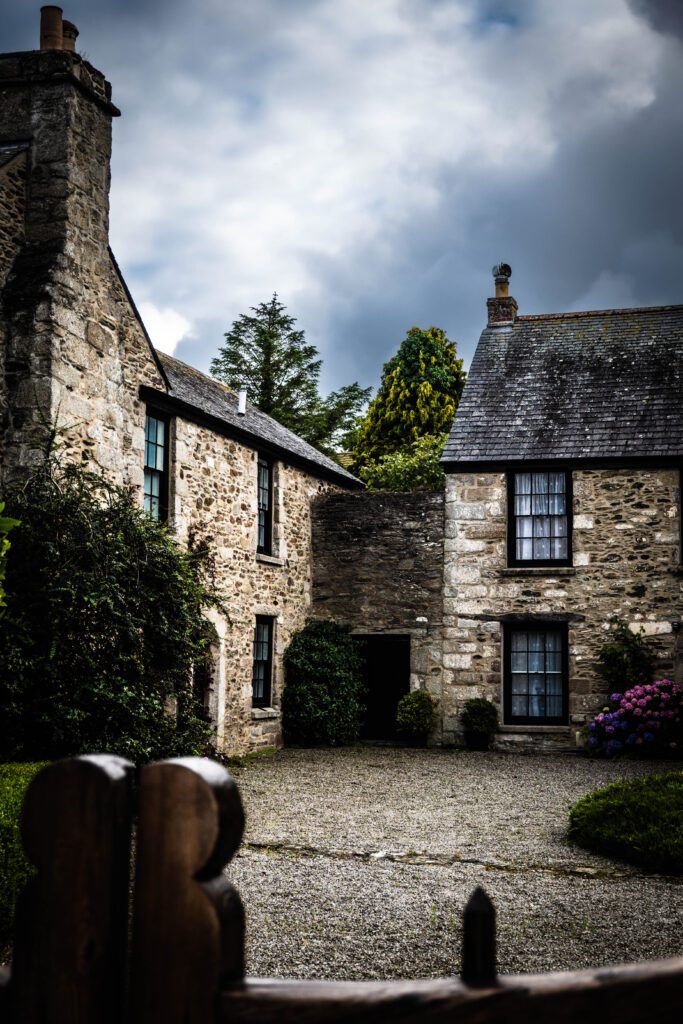
Very little remains of the original Arwenack House, though parts of its 15th-century walls survive within a later Georgian building near Falmouth’s waterfront. The nearby Arwenack Green is open to the public, with an impressive tree, lawns, and sea air, watched over by the weathered pyramid built by Martin Lister-Killigrew.
From here you can trace the shape of history: to the north, the bustling quays and cafés of modern Falmouth, and to the south, Pendennis Castle, still standing proud above the headland. Between them lies the story of a family whose ambition birthed a town—and whose name, though long vanished from the peerage, still lingers in the stones, streets, and stories of Falmouth.
The Legacy of Arwenack
In the end, Arwenack’s tale is not one of tragedy but transformation. The Killigrews may have fallen, but their creation thrives. Falmouth, with its art scene, maritime heritage, and global port, is the living continuation of a dream first imagined on that quiet Cornish shore.
Arwenack reminds us that every place we visit carries the echoes of lives lived before us of courage, folly, and persistence. It’s a story written not just in ruins and archives, but in the spirit of a town that still looks out to sea, forever ready for the next adventure.
-
Arwenack House
A manor house which was once part of the Arwenack Estate. Mostly lived in by the Killigrew family, who founded Falmouth in 1661.