St. Anthony Lighthouse: The Sentinel of Falmouth’s Eastern Shore
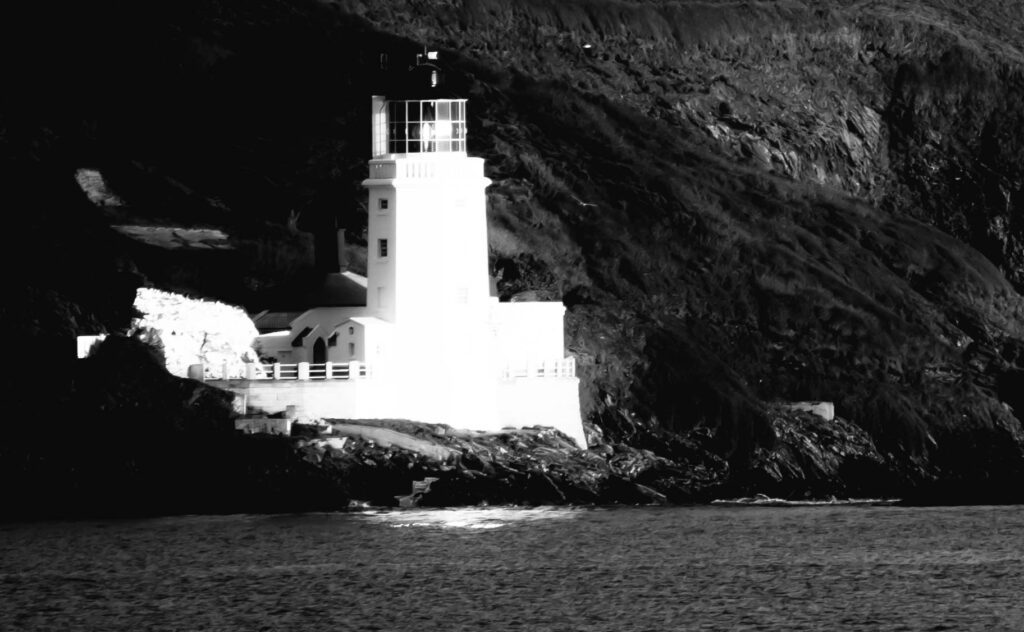
Perched proudly on the rugged cliffs of St. Anthony Head, overlooking the vast blue sweep of Falmouth Harbour, stands one of Cornwall’s most iconic maritime sentinels — St. Anthony Lighthouse. For nearly two centuries, this steadfast tower has cast its beam across the entrance to the harbour, guiding generations of sailors safely past the treacherous Manacles and into the calm waters of Carrick Roads. Its white cylindrical tower, framed by wind-tossed grasses and the restless Atlantic beyond, remains both a symbol of safety and a striking testament to Cornwall’s seafaring heritage.
A Beacon Born of Necessity
The story of St. Anthony Lighthouse begins long before the tower’s first light was kindled in 1835. As early as the 17th century, the Killigrew family — the founders of nearby Falmouth — flew a large red flag from an elm tree on St. Anthony Head. It was a simple but effective navigational signal for mariners. However, this makeshift aid was taken down in 1779, amid fears that invading fleets could use it to navigate the coast.
By the early 19th century, the bustling port of Falmouth had grown into one of Britain’s key maritime hubs. Ships arriving from across the Atlantic needed reliable guidance through the narrow and rocky entrance to the harbour, particularly to avoid The Manacles, a deadly cluster of submerged rocks that had claimed many vessels. In December 1830, Falmouth’s mayor and leading shipowners petitioned Trinity House, the authority responsible for Britain’s lighthouses, to erect a proper light on St. Anthony Head. Their appeal was heard, and a plan was drawn up by James Walker, Trinity House’s distinguished consulting engineer.
Lighting the Way
Construction was undertaken by Olver of Falmouth, and on Easter Monday, 20 April 1835, St. Anthony Lighthouse shone its light for the very first time. The event was celebrated with enthusiasm — “immense crowds” gathered around the newly built tower, with stalls and booths adding to the festive air.
The original light was a marvel of its age. It used eight Argand oil lamps, mounted on a revolving frame fitted with catoptric reflectors, which projected flashes of brilliant light once every twenty seconds. A clockwork mechanism powered the rotation — a sophisticated piece of Victorian engineering that required constant attention from the lighthouse keepers.
A Notice to Mariners issued by Trinity House described the new light as being “readily distinguishable from all other Lights in that vicinity,” thanks to its quick, regular flashes. Its purpose was twofold: to guide vessels safely into Falmouth Harbour, and, when used in conjunction with the Lizard Lighthouse, to help them steer clear of the perilous Manacles reef.
Life at the Lighthouse
In its earliest days, life for the keepers of St. Anthony was both isolated and demanding. The principal keeper and his family actually lived inside the tower, while the assistant keeper resided in a nearby cottage connected by a covered walkway. In 1865, a second light was added — remarkably, it shone from a window in the keeper’s living room — to illuminate the direction of the Manacles. Later, this auxiliary lamp was moved to a small hut just twenty feet from the tower.
That same year, a fog bell was installed to warn mariners during poor visibility. This was no small instrument — the bell weighed two tons, measured five feet across, and was said to be the heaviest bell in Cornwall. It was mounted on the gallery’s front and driven by a complex system of descending weights. During foggy weather, the same mechanism that rotated the optic also tolled the bell four times a minute, echoing eerily across the water.
From Oil to Electricity
By the turn of the 20th century, technological progress was transforming Britain’s lighthouses. Yet St. Anthony’s was among the last to retain its old system of oil lamps and reflectors — long after others had adopted the superior Fresnel lens, which magnified and focused the light more efficiently.
That changed around 1912, when the lighthouse underwent a major modernization. The old reflectors were replaced by a first-order fixed Fresnel optic, and the light source was upgraded to pressure vapour lamps. The new system produced a steady beam that was occulted (or briefly dimmed) every twenty seconds to create a distinctive pattern. To accommodate the massive glass lens, the lantern room itself was raised in height. At this stage, the small subsidiary light was discontinued, replaced by a red sector within the main beam — a warning for ships approaching the Manacles.
The next great leap came in 1954, when electricity reached the headland. The lighthouse was fitted with a 24-kilowatt filament lamp, greatly increasing its power and reliability. At the same time, the old fog bell — now obsolete — was silenced and removed. In its place came an experimental electric foghorn, using thirty-five Tannoy emitters to broadcast its mournful note across the sea. The bell, once the proud voice of St. Anthony’s, was given to Penwerris Church in Falmouth. It sat for many years on the church lawn before being melted down.
Automation and Modern Times
In 1987, after 152 years of continuous manned operation, St. Anthony Lighthouse was automated. Today, its operation is overseen remotely from Trinity House’s Planning Centre in Harwich, Essex. The light — now using modern optics and energy-efficient lamps — emits a white flash every fifteen seconds, with a red sector marking the direction of The Manacles. Its range was once an impressive 22 nautical miles, but in 2022, it was reduced to 12 nautical miles (and 9 for the red sector) to better match modern navigation systems.
Standing 19 metres high, with its light 22 metres above mean high water, St. Anthony’s continues to serve as a crucial guide at the mouth of Falmouth Harbour, also known as Carrick Roads — one of the largest natural harbours in the world. Though technology has changed, the lighthouse remains a constant presence in an ever-evolving maritime landscape.
On the Trail to St. Anthony
For today’s visitor, reaching St. Anthony Lighthouse is an adventure in itself. The walk from the National Trust car park at St. Anthony Head offers sweeping views over Falmouth Bay and the twin castles of Pendennis and St. Mawes, built by Henry VIII to defend the coast. The path winds through heathland and along the cliff edge, alive with seabirds and wildflowers, before arriving at the gleaming white tower overlooking the churning waters below.
While the lighthouse itself is not open to the public, the surrounding area offers plenty to explore. The nearby St. Anthony Battery, built in the 19th century to guard the harbour entrance, still houses wartime gun emplacements and observation posts. Information boards detail the site’s military history, while the views from here — across to Falmouth and out to sea — are breathtaking.
A Lighthouse of Popular Culture
Even those who’ve never been to Cornwall may find St. Anthony’s oddly familiar. Its striking silhouette featured in the opening sequence of the UK version of Jim Henson’s Fraggle Rock, reimagined as the “Fraggle Rock Lighthouse.” The keeper’s cottage, clinging to the headland, was portrayed as the home of the kindly lighthouse keeper from the beloved children’s series. It also made a cameo in Tots TV, another nostalgic British children’s show — a fitting tribute to a building that has long captured the imagination.
Enduring Legacy
Today, St. Anthony Lighthouse remains one of the most photographed spots in Cornwall — a favourite of painters, hikers, and sea-watchers alike. Its stark white tower against the ever-changing Cornish sky is more than a relic of maritime history; it is a living symbol of endurance, craftsmanship, and the eternal relationship between Cornwall and the sea.
As the gulls wheel overhead and the waves crash below, the light continues its steady rhythm — a heartbeat in the landscape — just as it has done since that first Easter Monday in 1835. Whether viewed from the cliffs of St. Anthony Head, from the decks of a passing boat, or across the waters of Falmouth Bay, it remains what it has always been: a faithful guardian of the Cornish coast, and a shining reminder of the human spirit’s ingenuity and perseverance against the vastness of the sea.